After a severe and protracted economic crisis in the late 1970s and early 1980s, New Zealand radically reformed its tax and banking systems, while also reducing regulation and protectionism, and liberalizing free trade. The results are impressive; the Heritage Foundation’s 2010 survey ranked New Zealand fourth in the world for economic freedom.The New Zealand government also had a tax surplus from 1994 to 2008.
New Zealand does not have capital gains or inheritance taxes. Interest and dividends are taxed as regular income. For individuals, very few expenses are deductible. For example, you cannot deduct mortgage interest or capital losses. The income tax form is short in comparison to the equivalent forms in the United States; for 2010 it consists of forty one “lines.” Property taxes (called “rates”) are low, and apply only to land, not to improvements or other forms of business property. Local city councils collect and spend rates.
[[MORE]]If you make a living working in a certain field, then New Zealand does not consider earnings from that work to be capital gains. For example, if you trade stocks for a living, then those gains would be taxable, whereas if you only make occasional investments in stocks while having a job in another field, then they would not be, nor would losses be deductible.
There are four personal income tax rate brackets. The rates for 2009 ranged from 12.5 to 38 percent, with the maximum rate applied to earnings over NZ$70,000. The rates declined slightly in 2010, and now range from 10.5 to 33 percent. You can claim a credit for income under NZ$9,880, with the effect that if you earn less than that, you will not owe any income tax. Seventy five percent of New Zealand residents are in the intermediate 17.5 percent bracket (up to NZ$48,000). The corporate tax rate is a flat 30 percent, and will be decreasing to 28 percent in 2011.
New Zealand bases personal income taxes on individual income only; there are no “joint” returns or brackets. As an example, assume a husband works and his wife stays at home and they have a joint savings account. The husband will owe tax on his earned income plus half of the interest income. His wife will owe tax only on half of the interest income, potentially at a much lower rate than her husband will.
Employers deduct most income taxes at the source, through the pay as you earn (PAYE) program. Banks and other financial institutions deduct taxes from interest and dividend payments through the resident withholding tax (RWT) program. One way that PAYE differs from RWT is that PAYE includes an additional 2% fee for no-fault accident insurance (ACC). Although New Zealand has a publicly funded healthcare system, people injured in an accident can receive additional benefits, such as physical therapy or compensation for lost wages.
One advantage of New Zealand’s approach to income taxes compared to the United States is that the end-to-end system is reasonably comprehensible by the public. It is possible to estimate accurately the impact of changes in income or tax rates on yourself as well as others. This helps facilitate better economic planning, which is important for a well-functioning economy. If you cannot plan, or if your planning is error prone, it is easy to make a wide variety of financial mistakes. For example, you might end up with a level of debt you cannot afford to service, or you might unnecessarily defer the purchase of assets that you could have put to good use.
The motivation for not taxing capital gains stems in part from a respect for property rights, as well as from a desire to limit the benefits government receives from inflation. When capital gains are taxable, inflation alone can cause a nominal gain, even when there is a loss of purchasing power. For example, if you buy an asset for $1,000, and after one year without inflation, you sell the asset for $900, you would have a $100 capital loss. Now assume that there is 20 percent per year inflation. The sales price would be $1,080; you would have an $80 capital gain, even though there is a loss in constant dollar terms. Inflation plus a capital gains tax will amplify your losses (and your gains) compared to depreciation alone.
New Zealand has a national sales tax called the goods and services tax (GST). Items that you purchase overseas and import into the country are also subject to GST, with a NZ$50 minimum threshold per transaction. Instead of the government providing exemptions for companies and individuals who collect GST on the goods and services they sell, those entities file periodic GST returns where they can claim a credit for GST they have paid. If they pay more in GST than they collect, they receive a refund.
Only a few goods and services are exempt from GST, such as donations to non-profits, which they then sell, financial services such as bank fees, and rent for a residential dwelling. The most interesting exemptions are for fine gold, silver and platinum. The combination of no capital gains tax and no GST has the potential of enabling a form of penalty-free trading using precious metals as money, although such a market has not yet materialized.
The GST tax rate started out at 10% when New Zealand introduced it in 1986; it went up later to 12.5 percent. As part of the legislative package that decreased income tax rates in 2010, GST increased from 12.5 to 15 percent.
In addition to GST, the government also imposes excise taxes (duties) on a number of imported items, including alcohol, tobacco, fuels, carpets, footwear, hats, apparel, bedding, cosmetics, amplifiers, and so on. Typical rates vary from 5 to 10 percent of cost.
A duty used to be payable on gifts over a certain amount. The government has decided to eliminate that tax in 2011, largely due to the high cost of administration compared with the relatively small revenue that was taken in. As a result, gifts of any size are now tax-free. This change also fits with not having an inheritance tax; the idea is that you pay taxes only when you earn the money, not when you give it away, either voluntarily or upon death.
The government raises roughly 45 percent of its total revenue from individual income taxes, and about 20 percent from GST. Corporate taxes, duties, investment income and other taxes make up the remainder.
New Zealand’s central bank is the Reserve Bank of New Zealand (RBNZ). The government restructured the RBNZ charter in 1989, in the aftermath of the financial crisis in the early 1980s. The law under which the government chartered the bank defines its primary function as providing stability in the general level of prices. New Zealand was the first country to adopt a formal inflation target. Unlike the Federal Reserve, the RBNZ charter does not include managing the level of employment or other aspects of the economy. New Zealand does not provide FDIC-like bank deposit insurance, whether through RBNZ or otherwise.
The combination of not allowing mortgage interest to be deductible, having a central bank focused on controlling inflation, and a lack of bank deposit insurance superficially discourages debt and inflation. Even so, it was not enough to prevent the country from having a modest real estate bubble; prices have roughly doubled over the last ten years.
Having lived with the New Zealand tax system since moving here from the United States four years ago, overall I find it to be a breath of fresh air. Eventually, I would like to see the country move to a more limited government that is entirely funded by voluntary fees. The purpose of government should be to protect our rights. Taxation requires force or the threat of force to enforce it. As a result, through this implicit or explicit force, government is violating our rights. This puts government in a constant state of both internal and external conflict: “violating your rights in order to protect them.”
In the near term, on the path to a voluntarily funded government, there are many things New Zealand could do, in addition to the often suggested “cut spending and taxes.” To encourage saving, which helps minimize the true cost of capital, I would like to see taxes on interest income eliminated. To help reverse the decline in domestic industrial growth, the government could reduce personal and corporate income taxes, and offset the revenue loss with an increase in import duties. Import duties are potentially avoidable, so they are a more moral option than income taxes. Import duties could also be made uniform, so they do not damage or benefit one industry more than another.
Friday, 16 September 2011

Wednesday, 14 September 2011
Update on brushing my teeth with soap
As I posted some time ago, I was brushing my teeth with soap instead of toothpaste. It worked great on my teeth and gums. However, I decided to stop a while back.
Because soap is a natural antibacterial, it was apparently disturbing the natural balance of bacteria in my mouth and throat -- to the point where I eventually got a bad case of thrush (yeast overgrowth), which was an unpleasant experience, to say the least.
This may not happen with everyone who brushes with soap; I think I'm sensitive in this area. It may also depend to some degree on the type of soap you use. You could probably also offset the antibacterial effect of soap by having a spoonful of acidophilus yoghurt after you brush.
The toothpaste I'm using now doesn't have sodium lauryl sulphate or fluoride, but it does have glycerin. Even so, I was encouraged at a recent dental hygiene appointment with no gum pocket depths greater than 3mm (5mm is considered the threshold for gum disease).
Because soap is a natural antibacterial, it was apparently disturbing the natural balance of bacteria in my mouth and throat -- to the point where I eventually got a bad case of thrush (yeast overgrowth), which was an unpleasant experience, to say the least.
This may not happen with everyone who brushes with soap; I think I'm sensitive in this area. It may also depend to some degree on the type of soap you use. You could probably also offset the antibacterial effect of soap by having a spoonful of acidophilus yoghurt after you brush.
The toothpaste I'm using now doesn't have sodium lauryl sulphate or fluoride, but it does have glycerin. Even so, I was encouraged at a recent dental hygiene appointment with no gum pocket depths greater than 3mm (5mm is considered the threshold for gum disease).
Sunday, 11 September 2011
An alternative to Left vs. Right in politics
The perennial Left vs. Right model in politics is terribly misleading. It presents a false dichotomy, and therefore a false choice. I thought it would be interesting to come up with a diagram that more accurately expresses the spectrum of political choices:

The X axis is the traditional Left vs. Right model. The Y axis shows the degree of sacrifice that's required from a particular political party or system. The political parties are shown in green, political systems are black, and the targets of sacrifice are red.
What I'm trying to show here is that the fundamental difference between the Left and the Right today is not, say, the support of individual rights vs. collectivism. Rather, they both advocate sacrifice, just to different targets. The Democrats want us to sacrifice ourselves to our neighbors, so they support egalitarianism, welfare programs of all kinds, and uses of taxation for both purposes. They are also strong supporters of various racist agendas, such as "equal opportunity" (a misnomer if there ever was one) and multiculturalism. The Republicans want us to sacrifice to corporations and the country (endless wars), and they have a strong religious agenda too.
[[MORE]]You can see where the fringe parties and political systems of today fall. The Greens want more sacrifice than the Democrats, by having us sacrifice ourselves to the environment. Anarchists advocate less sacrifice than Democrats, while often still preaching egalitarianism or other forms of sacrifice to your neighbor, or sacrifice all-to-all. The Tea Party wants a little less sacrifice than Republicans, by being against sacrifice to corporations, but they would be happy to sacrifice to God and country.
Although there are certainly atheists in the Libertarian camp, my experience with them as a group is that they tend to support sacrificing themselves to God to some degree. Since they adopt the non-initiation of force principle as a primary (rather than in an appropriate context), they also tend to be pacifists who support sacrificing themselves to their enemies. However, they generally prefer eliminating sacrifice to both corporations and the country.
As we move down the Y axis, true socialist governments take sacrificing to your neighbor to even greater extremes with actions such as government ownership of major industries. The people of Nazi Germany sacrificed themselves to the Aryan race; that was the true name in which many of their atrocities were committed. Italian-style Fascism demanded sacrifice to the country (Nationalism) and happily created a marriage of corporations with the State. Theistic states such as Iran demand sacrifice to God.
At the level of total sacrifice, we have communism on the left, such as in the Soviet Union, where private property and working for profit ("speculation") were outlawed. On the right, we have totalitarianism, which would be a type of feudalism, where a King rules by fiat.
At the top of the diagram's triangle, not sacrificing to anyone means supporting individual rights as a primary, which leads to laissez-faire capitalism. This is a "hands off" type of capitalism, limited mainly by laws against the use of force or fraud, but free of modern regulation.
The diagram also helps to illustrate the tendency of humans when it comes to politics to move down the Y axis, toward increasing levels of sacrifice -- which also naturally leads to increasing violence and war. Jumps up the Y axis are relatively rare, yet also very powerful when they do happen, such as with The Enlightenment.
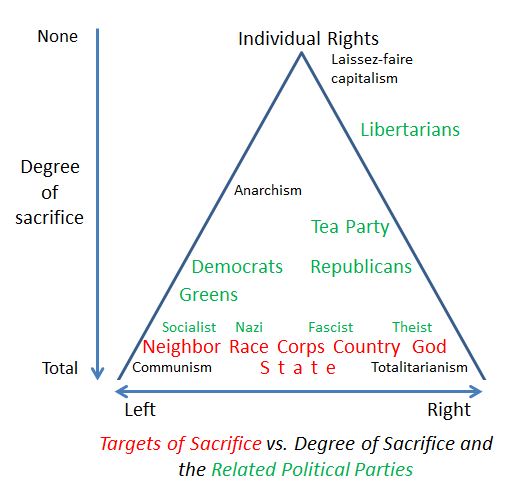
The X axis is the traditional Left vs. Right model. The Y axis shows the degree of sacrifice that's required from a particular political party or system. The political parties are shown in green, political systems are black, and the targets of sacrifice are red.
What I'm trying to show here is that the fundamental difference between the Left and the Right today is not, say, the support of individual rights vs. collectivism. Rather, they both advocate sacrifice, just to different targets. The Democrats want us to sacrifice ourselves to our neighbors, so they support egalitarianism, welfare programs of all kinds, and uses of taxation for both purposes. They are also strong supporters of various racist agendas, such as "equal opportunity" (a misnomer if there ever was one) and multiculturalism. The Republicans want us to sacrifice to corporations and the country (endless wars), and they have a strong religious agenda too.
[[MORE]]You can see where the fringe parties and political systems of today fall. The Greens want more sacrifice than the Democrats, by having us sacrifice ourselves to the environment. Anarchists advocate less sacrifice than Democrats, while often still preaching egalitarianism or other forms of sacrifice to your neighbor, or sacrifice all-to-all. The Tea Party wants a little less sacrifice than Republicans, by being against sacrifice to corporations, but they would be happy to sacrifice to God and country.
Although there are certainly atheists in the Libertarian camp, my experience with them as a group is that they tend to support sacrificing themselves to God to some degree. Since they adopt the non-initiation of force principle as a primary (rather than in an appropriate context), they also tend to be pacifists who support sacrificing themselves to their enemies. However, they generally prefer eliminating sacrifice to both corporations and the country.
As we move down the Y axis, true socialist governments take sacrificing to your neighbor to even greater extremes with actions such as government ownership of major industries. The people of Nazi Germany sacrificed themselves to the Aryan race; that was the true name in which many of their atrocities were committed. Italian-style Fascism demanded sacrifice to the country (Nationalism) and happily created a marriage of corporations with the State. Theistic states such as Iran demand sacrifice to God.
At the level of total sacrifice, we have communism on the left, such as in the Soviet Union, where private property and working for profit ("speculation") were outlawed. On the right, we have totalitarianism, which would be a type of feudalism, where a King rules by fiat.
At the top of the diagram's triangle, not sacrificing to anyone means supporting individual rights as a primary, which leads to laissez-faire capitalism. This is a "hands off" type of capitalism, limited mainly by laws against the use of force or fraud, but free of modern regulation.
The diagram also helps to illustrate the tendency of humans when it comes to politics to move down the Y axis, toward increasing levels of sacrifice -- which also naturally leads to increasing violence and war. Jumps up the Y axis are relatively rare, yet also very powerful when they do happen, such as with The Enlightenment.
Friday, 9 September 2011
Would you take statins for high cholesterol?
If I had high cholesterol, I wouldn't statin drugs, for two reasons. First, from what I've seen, the research is not clear that reducing cholesterol levels has any real long-term benefit with regard to heart disease. Second, the drugs themselves have a terrible side-effect profile. For those who decide to go that way, though, be sure to take Co-Q10 to help minimize the damage.
I had a heart scan done myself about 5 yrs ago, and would highly recommend the procedure. Although mine came back clear, I could imagine that having someone tell you that they suspect plaque has started to form in the vessels affecting your heart is nothing like actually seeing and measuring them.
Instead of statins, look into the Pauling/Rath protocol for reversing heart disease. Basically, Lysine, Proline, Vitamin C, Co-Q10, Carnitine, Niacin and Vit E.
[[MORE]]Arginine supplementation can also be useful. It helps by increasing nitric oxide release in tissues, which in turn promotes wound healing (such as in the arterial walls; plaques form in response to wall damage), and helps to dilate blood vessels. Dr Joe Prendergrast's work in this area is very interesting.
If the heart scan does show some calcification, consider having EDTA chelation therapy, which can help dissolve the plaques. It's a slow process (once a week for 20+ weeks), but it has a pretty good track record, particularly when the plaques aren't too thick. The most effective approach is by IV, but it can also be done using EDTA suppositories -- the latter takes longer and requires some care in administration, but you might prefer it to getting stuck with an IV needle. Used in conjunction with a heart scan, you can actually track your progress.
Watch your blood pressure. High BP can damage blood vessels; repeated micro-damage means more plaques.
Also, watch/limit your calcium intake and Vit D level. There is a bunch of interesting work in this area. Tom Levy of Vit C fame was planning a book on the subject.
I had a heart scan done myself about 5 yrs ago, and would highly recommend the procedure. Although mine came back clear, I could imagine that having someone tell you that they suspect plaque has started to form in the vessels affecting your heart is nothing like actually seeing and measuring them.
Instead of statins, look into the Pauling/Rath protocol for reversing heart disease. Basically, Lysine, Proline, Vitamin C, Co-Q10, Carnitine, Niacin and Vit E.
[[MORE]]Arginine supplementation can also be useful. It helps by increasing nitric oxide release in tissues, which in turn promotes wound healing (such as in the arterial walls; plaques form in response to wall damage), and helps to dilate blood vessels. Dr Joe Prendergrast's work in this area is very interesting.
If the heart scan does show some calcification, consider having EDTA chelation therapy, which can help dissolve the plaques. It's a slow process (once a week for 20+ weeks), but it has a pretty good track record, particularly when the plaques aren't too thick. The most effective approach is by IV, but it can also be done using EDTA suppositories -- the latter takes longer and requires some care in administration, but you might prefer it to getting stuck with an IV needle. Used in conjunction with a heart scan, you can actually track your progress.
Watch your blood pressure. High BP can damage blood vessels; repeated micro-damage means more plaques.
Also, watch/limit your calcium intake and Vit D level. There is a bunch of interesting work in this area. Tom Levy of Vit C fame was planning a book on the subject.
Sunday, 17 July 2011
Leg cramps
I used to get leg cramps, and have researched the causes thoroughly.
What I found is that the most common cause is not having enough magnesium. The second most common cause is getting too much calcium. Other micronutrient or electrolyte imbalances can also play a role.
Calcium is required by muscles in order for them to contract, and magnesium is required in order for them to relax. There are many factors that can lead to magnesium deficiency, including exposure to toxins in your food or environment. Some people also tend to leak magnesium from their kidneys when they are totally well, and so can be in a chronic state of deficiency, even when on a good diet.
If you're having cramps, you might try dramatically increasing your magnesium intake, while reducing calcium as much as you can, until the cramps abate (if you get too much, you'll find it's a natural laxative). There are many different forms of magnesium supplements; some are much more readily absorbed than others. I prefer the amino acid chelates, although I've also found mag citrate ("Natural Calm") to be effective when taken in sufficient quantity.
[[MORE]]At high doses, calcium is actually a cellular toxin. I worked with a very bright doc once (Robert Cathcart, of Vit C fame), who had a theory that calcium toxicity was responsible for osteoporosis, and contributed much to heart disease.
Another thing to try is Epsom salt baths: take about 250 grams of Epsom salts (about a half-pound) and dissolve them in a bath full of warm-to-hot water, and soak for 30 to 60 minutes. Finish the bath at least an hour before bed, to allow your body time to cool down before you go to sleep. When the cramping in my legs used to get bad, I found this was one of the most effective things I could do to help.
What I found is that the most common cause is not having enough magnesium. The second most common cause is getting too much calcium. Other micronutrient or electrolyte imbalances can also play a role.
Calcium is required by muscles in order for them to contract, and magnesium is required in order for them to relax. There are many factors that can lead to magnesium deficiency, including exposure to toxins in your food or environment. Some people also tend to leak magnesium from their kidneys when they are totally well, and so can be in a chronic state of deficiency, even when on a good diet.
If you're having cramps, you might try dramatically increasing your magnesium intake, while reducing calcium as much as you can, until the cramps abate (if you get too much, you'll find it's a natural laxative). There are many different forms of magnesium supplements; some are much more readily absorbed than others. I prefer the amino acid chelates, although I've also found mag citrate ("Natural Calm") to be effective when taken in sufficient quantity.
[[MORE]]At high doses, calcium is actually a cellular toxin. I worked with a very bright doc once (Robert Cathcart, of Vit C fame), who had a theory that calcium toxicity was responsible for osteoporosis, and contributed much to heart disease.
Another thing to try is Epsom salt baths: take about 250 grams of Epsom salts (about a half-pound) and dissolve them in a bath full of warm-to-hot water, and soak for 30 to 60 minutes. Finish the bath at least an hour before bed, to allow your body time to cool down before you go to sleep. When the cramping in my legs used to get bad, I found this was one of the most effective things I could do to help.
Wednesday, 6 July 2011
Propaganda techniques used by Fox News
Reposted from: http://www.truth-out.org/print/3753
There is nothing more sacred to the maintenance of democracy than a free press. Access to comprehensive, accurate and quality information is essential to the manifestation of Socratic citizenship - the society characterized by a civically engaged, well-informed and socially invested populace. Thus, to the degree that access to quality information is willfully or unintentionally obstructed, democracy itself is degraded.
[[MORE]]It is ironic that in the era of 24-hour cable news networks and "reality" programming, the news-to-fluff ratio and overall veracity of information has declined precipitously. Take the fact Americans now spend on average about 50 hours a week using various forms of media, while at the same time cultural literacy levels hover just above the gutter. Not only does mainstream media now tolerate gross misrepresentations of fact and history by public figures (highlighted most recently by Sarah Palin's ludicrous depiction of Paul Revere's ride), but many media actually legitimize these displays. Pause for a moment and ask yourself what it means that the world's largest, most profitable and most popular news channel passes off as fact every whim, impulse and outrageously incompetent analysis of its so-called reporters. How did we get here? Take the enormous amount of misinformation that is taken for truth by Fox audiences: the belief that Saddam Hussein had weapons of mass destruction (WMD) and that he was in on 9/11, the belief that climate change isn't real and/or man-made, the belief that Barack Obama is Muslim and wasn't born in the United States, the insistence that all Arabs are Muslim and all Muslims are terrorists, the inexplicable perceptions that immigrants are both too lazy to work and are about to steal your job. All of these claims are demonstrably false, yet Fox News viewers will maintain their veracity with incredible zeal. Why? Is it simply that we have lost our respect for knowledge?
My curiosity about this question compelled me to sit down and document the most oft-used methods by which willful ignorance has been turned into dogma by Fox News and other propagandists disguised as media. The techniques I identify here also help to explain the simultaneously powerful identification the Fox media audience has with the network, as well as their ardent, reflexive defenses of it.
The good news is that the more conscious you are of these techniques, the less likely they are to work on you. The bad news is that those reading this article are probably the least in need in of it.
1. Panic Mongering. This goes one step beyond simple fear mongering. With panic mongering, there is never a break from the fear. The idea is to terrify and terrorize the audience during every waking moment. From Muslims to swine flu to recession to homosexuals to immigrants to the rapture itself, the belief over at Fox seems to be that if your fight-or-flight reflexes aren't activated, you aren't alive. This of course raises the question: why terrorize your own audience? Because it is the fastest way to bypasses the rational brain. In other words, when people are afraid, they don't think rationally. And when they can't think rationally, they'll believe anything.
2. Character Assassination/Ad Hominem. Fox does not like to waste time debating the idea. Instead, they prefer a quicker route to dispensing with their opponents: go after the person's credibility, motives, intelligence, character, or, if necessary, sanity. No category of character assassination is off the table and no offense is beneath them. Fox and like-minded media figures also use ad hominem attacks not just against individuals, but entire categories of people in an effort to discredit the ideas of every person who is seen to fall into that category, e.g. "liberals," "hippies," "progressives" etc. This form of argument - if it can be called that - leaves no room for genuine debate over ideas, so by definition, it is undemocratic. Not to mention just plain crass.
3. Projection/Flipping. This one is frustrating for the viewer who is trying to actually follow the argument. It involves taking whatever underhanded tactic you're using and then accusing your opponent of doing it to you first. We see this frequently in the immigration discussion, where anti-racists are accused of racism, or in the climate change debate, where those who argue for human causes of the phenomenon are accused of not having science or facts on their side. It's often called upon when the media host finds themselves on the ropes in the debate.
4. Rewriting History. This is another way of saying that propagandists make the facts fit their worldview. The Downing Street Memos on the Iraq war were a classic example of this on a massive scale, but it happens daily and over smaller issues as well. A recent case in point is Palin's mangling of the Paul Revere ride, which Fox reporters have bent over backward to validate. Why lie about the historical facts, even when they can be demonstrated to be false? Well, because dogmatic minds actually find it easier to reject reality than to update their viewpoints. They will literally rewrite history if it serves their interests. And they'll often speak with such authority that the casual viewer will be tempted to question what they knew as fact.
(continues)
Fourteen Propaganda Techniques Fox "News" Uses to Brainwash Americans
There is nothing more sacred to the maintenance of democracy than a free press. Access to comprehensive, accurate and quality information is essential to the manifestation of Socratic citizenship - the society characterized by a civically engaged, well-informed and socially invested populace. Thus, to the degree that access to quality information is willfully or unintentionally obstructed, democracy itself is degraded.
[[MORE]]It is ironic that in the era of 24-hour cable news networks and "reality" programming, the news-to-fluff ratio and overall veracity of information has declined precipitously. Take the fact Americans now spend on average about 50 hours a week using various forms of media, while at the same time cultural literacy levels hover just above the gutter. Not only does mainstream media now tolerate gross misrepresentations of fact and history by public figures (highlighted most recently by Sarah Palin's ludicrous depiction of Paul Revere's ride), but many media actually legitimize these displays. Pause for a moment and ask yourself what it means that the world's largest, most profitable and most popular news channel passes off as fact every whim, impulse and outrageously incompetent analysis of its so-called reporters. How did we get here? Take the enormous amount of misinformation that is taken for truth by Fox audiences: the belief that Saddam Hussein had weapons of mass destruction (WMD) and that he was in on 9/11, the belief that climate change isn't real and/or man-made, the belief that Barack Obama is Muslim and wasn't born in the United States, the insistence that all Arabs are Muslim and all Muslims are terrorists, the inexplicable perceptions that immigrants are both too lazy to work and are about to steal your job. All of these claims are demonstrably false, yet Fox News viewers will maintain their veracity with incredible zeal. Why? Is it simply that we have lost our respect for knowledge?
My curiosity about this question compelled me to sit down and document the most oft-used methods by which willful ignorance has been turned into dogma by Fox News and other propagandists disguised as media. The techniques I identify here also help to explain the simultaneously powerful identification the Fox media audience has with the network, as well as their ardent, reflexive defenses of it.
The good news is that the more conscious you are of these techniques, the less likely they are to work on you. The bad news is that those reading this article are probably the least in need in of it.
1. Panic Mongering. This goes one step beyond simple fear mongering. With panic mongering, there is never a break from the fear. The idea is to terrify and terrorize the audience during every waking moment. From Muslims to swine flu to recession to homosexuals to immigrants to the rapture itself, the belief over at Fox seems to be that if your fight-or-flight reflexes aren't activated, you aren't alive. This of course raises the question: why terrorize your own audience? Because it is the fastest way to bypasses the rational brain. In other words, when people are afraid, they don't think rationally. And when they can't think rationally, they'll believe anything.
2. Character Assassination/Ad Hominem. Fox does not like to waste time debating the idea. Instead, they prefer a quicker route to dispensing with their opponents: go after the person's credibility, motives, intelligence, character, or, if necessary, sanity. No category of character assassination is off the table and no offense is beneath them. Fox and like-minded media figures also use ad hominem attacks not just against individuals, but entire categories of people in an effort to discredit the ideas of every person who is seen to fall into that category, e.g. "liberals," "hippies," "progressives" etc. This form of argument - if it can be called that - leaves no room for genuine debate over ideas, so by definition, it is undemocratic. Not to mention just plain crass.
3. Projection/Flipping. This one is frustrating for the viewer who is trying to actually follow the argument. It involves taking whatever underhanded tactic you're using and then accusing your opponent of doing it to you first. We see this frequently in the immigration discussion, where anti-racists are accused of racism, or in the climate change debate, where those who argue for human causes of the phenomenon are accused of not having science or facts on their side. It's often called upon when the media host finds themselves on the ropes in the debate.
4. Rewriting History. This is another way of saying that propagandists make the facts fit their worldview. The Downing Street Memos on the Iraq war were a classic example of this on a massive scale, but it happens daily and over smaller issues as well. A recent case in point is Palin's mangling of the Paul Revere ride, which Fox reporters have bent over backward to validate. Why lie about the historical facts, even when they can be demonstrated to be false? Well, because dogmatic minds actually find it easier to reject reality than to update their viewpoints. They will literally rewrite history if it serves their interests. And they'll often speak with such authority that the casual viewer will be tempted to question what they knew as fact.
(continues)
Thursday, 23 June 2011
Example of conservative investing results in New Zealand
Let's look at what would have happened if you bought New Zealand dollars (using US dollars) 4 years ago, held them in a savings account in a bank, and sold them today. To keep the math easy, let's assume you're in a low tax bracket and don't pay taxes (hey, that's half the US now, right?).
mid-2007: Buy US$100 worth of NZ dollars. Exchange rate = 0.68 USD/NZD, so net = NZ$147.06
mid-2007 to mid-2008: Interest rate for savings account 7.4%, so NZ$157.94 at the end of the year
2008 to 2009: 7.2% --> NZ$169.31
2009 to 2010: 6.0% --> NZ$179.47
2010 to 2011: 5.0% --> NZ$188.45
mid-2011: Exchange NZ$188.45 back to USD. Current exchange rate = 0.81 USD/NZD, so net = US$152.64
That's a 52% gain over 4 years, or 11% compounded annually. 19% of the gain came from a weakening USD vs. NZD alone.
For comparison, gold has about doubled in USD terms over the same period, but pure USD deposits are up only a few percent.
mid-2007: Buy US$100 worth of NZ dollars. Exchange rate = 0.68 USD/NZD, so net = NZ$147.06
mid-2007 to mid-2008: Interest rate for savings account 7.4%, so NZ$157.94 at the end of the year
2008 to 2009: 7.2% --> NZ$169.31
2009 to 2010: 6.0% --> NZ$179.47
2010 to 2011: 5.0% --> NZ$188.45
mid-2011: Exchange NZ$188.45 back to USD. Current exchange rate = 0.81 USD/NZD, so net = US$152.64
That's a 52% gain over 4 years, or 11% compounded annually. 19% of the gain came from a weakening USD vs. NZD alone.
For comparison, gold has about doubled in USD terms over the same period, but pure USD deposits are up only a few percent.
Subscribe to:
Posts (Atom)