Showing posts with label Paleo. Show all posts

Saturday, 24 July 2010

Troubleshooting low-carb

Are you eating Paleo, and yet often still hungry at the end of a meal? If so, it may be due to low blood sugar. One of the body’s responses to low blood sugar is to make you feel hungry. Why might your blood sugar so low? One possibility is that you are eating too much protein. The protein will cause insulin to be released, which will then lower your blood sugar (the opposite of what you need at that point). Another is that you had carbs at an earlier time in the day, and that after the initial spike in blood sugar, your body has over-corrected into a blood sugar low. This is “hypoglycemia,” and is very common.

The solution is to cut back on protein and carbs. What happens when you cut back both protein and carbs is that fat, as a percentage of total calories, needs to go up; fat also tends to be very satiating.

This type of diet change does take time. However, once your body enters fat-burning mode (which is indicated by being in ketosis), one benefit is that most people tend to get hungry much less often; for example, I can generally go at least 15 hours between meals without feeling hungry. That also means less cooking. Being in ketosis also means that your insulin levels are at their lowest, which will minimize blood sugar swings, which is part of why it helps resolve hunger issues. You do have to be careful about increasing fat without also decreasing carbs. If you don’t cut back on carbs, the resulting high insulin levels are a pretty sure-fire way to gain weight; yet most people will actually lose weight on a high-fat, low-carb, low-protein diet. In addition to controlling blood sugar, insulin also acts as a “storage hormone,” which causes excess calories to be stored as fat.

[[MORE]]I know many people have trouble giving up sweets. I was in that camp myself, in fact. I tried fake sweets years ago, but found they actually made things worse, by constantly reminding me of what I couldn’t have. My ultimate solution (not for everyone!) was to replace sweets with bitters: things like cocoa, coffee and dark green veggies. After a few months of that, not only do I not find those things bitter any more, on the few occasions when I’ve tasted something sweet, they now generally taste sickly-sweet to me.

If you have fat tolerance issues, you might try taking a lipase-containing supplement with your meals. Lipase is an enzyme that helps to break down fats. You might also try several different types of fat, to see if you tolerate some better than others (butter vs. cream, for example, or cooked vs. not); even the texture can make a difference. A few ideas to help increase your overall fat intake:

  • Add cream when cooking your meat. It helps dissolve the grease, and adds tremendously to the flavor.

  • Mix your avocados with a little olive oil – can be great in salads.

  • Try a half-cream / half-milk beverage as desert; possibly with a little coffee or cocoa (also an option for a quick meal).

  • When cooking eggs, try tossing out an occasional egg white to decrease protein and increase fat. You can also add a few tbsps of cream to your eggs; plenty of cheese is nice, too.

  • If you like bacon, and like the taste but not the greasy feel of the grease, cook the bacon first, then toss about half the resulting grease, and cook eggs in the same pan. Adds lots of flavor to the eggs, and doesn’t taste greasy at all.

  • Use plenty of butter and/or some occasional cream when cooking your veggies.

  • Retain and eat the skin on chicken, rather than tossing it out (plenty of fat; very tasty).

  • Buy less expensive cuts of meat; the ones with a higher fat content (more marbling, etc).

  • Add grated cheese liberally to veggies and meat.

  • Drink your coffee or tea with plenty of cream.

  • For a quick, no-think meal, try full-fat unsweetened / no-fruit yoghurt with a few drops of vanilla; the one I get is only about 5% carbs.


You could also try blenderizing your cream a little before using it, to see if it improves digestability for you by breaking up some of the fat globules (avoid too much blenderizing, though, or you’ll end up making butter).

Also, in addition to a diary, you might consider tracking the composition of the foods you eat on a site like fitday.com—at least for a few days. That will help you see how much of your meals are carbs vs. protein vs. fat. That can also help you find “hidden” sources of carbs in your diet (for me, it was too many nuts).

Friday, 9 July 2010

More about what "Paleo" means to me

For me, Paleo is not about Paleolithic food or lifestyle reenactment. I enjoy my modern lifestyle very much. There are certain Neolithic foods that I think are proper and healthy--dairy, for example. I also think it’s a good idea to apply scientific reasoning on top of what we know about the way our ancestors ate. In other words, there may be big difference between a diet based on Paleolithic food reenactment and one that is oriented toward optimal health.

One thing that Taubes (Good Calories, Bad Calories) and others have clearly shown is the idea that minimizing insulin levels and insulin resistance is extremely important for long-term health. “High fat Paleo” is one way to accomplish that (it’s not just carbs that cause insulin production; protein does, too).

[[MORE]]In terms of evolutionary reasoning, there were many sources of fat in the Paleolithic world. In addition to the larger animals that Monica mentioned, Paleolithic people also ate the entire animal, including the marrow, skin and the brain, which are fatty. I have no doubt that bird eggs have been consumed by man for ages, and egg yolks are fatty. In fact, many birds are themselves reasonably fatty. Some indigenous peoples consider grubs to be a delicacy, and they are fatty. As a dense calorie source and something that’s normally very tasty and satiating, it wouldn’t surprise me if Paleo people were attracted to fat over protein.

I also don’t think that the exact diet of Paleolithic people is well-known enough or was consistent enough for it to be the sole foundation of what we eat today. Personally, I would rather have my diet be a Paleo-inspired, but science-driven approach.

Monday, 10 May 2010

Risk factors for cardiac mortality

Great post at Hyperlipid.

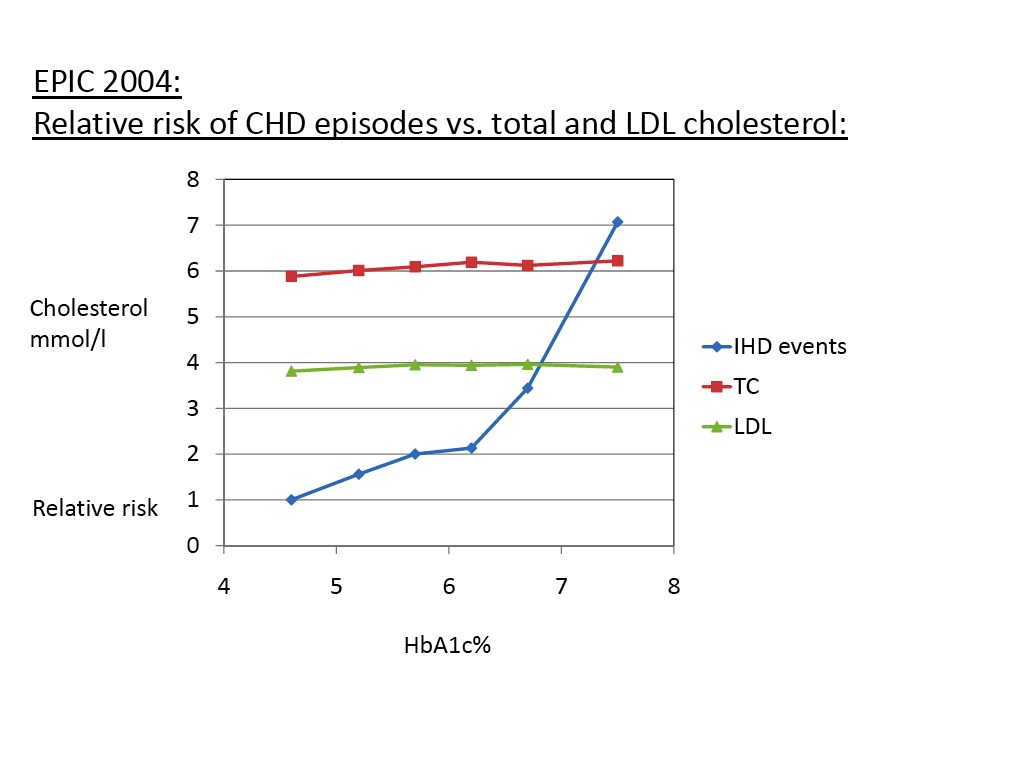
The whole article is interesting, but the graph below is the kicker:

Relative risk of CHD episodes vs total and LDL cholesterol and HbA1c

Notice that as HbA1c increases, particularly over about 6.2%, the risk of a cardiac episode increases dramatically.

Also notice that there is no indication that high cholesterol with a low HbA1c increases the risk of cardiac mortality.

In other words, an important goal for any heart disease prevention diet should be to minimize HbA1c. How do you do that? Minimize blood glucose -- and the most effective solution there is to reduce simple carbs and increase fat.

Thursday, 15 April 2010

Which salt to use?

The sea salt I use (Lotus Macrobiotic Sea Salt / fine grain) is 83% sodium chloride and 7% water. A full 10% is a mix of about 80 different minerals, including potassium, sulphur, zinc, magnesium, potassium, manganese, copper, calcium, silicon, iodine and more. It is slightly gray in color, and somewhat chunky (although it dissolves very easily in water).

In comparison, standard table salt is 99.9% sodium chloride. In addition to 0.01% potassium iodide, it sometimes has things like aluminum silicate added to help it stay powdery (some brands also have a small amount of sugar added to them). I think of table salt more as a drug than a food.

[[MORE]]I've tried a number of different brands of sea salt. They vary depending on where and how the salt is harvested and cured/dried. I've noticed a surprising difference in taste from one brand to another. The Lotus brand I mentioned above comes from Spain. I've had another brand that originates in Baja California that's also good. I haven't enjoyed the "Celtic" brands nearly as much.

An tidbit from a (long-term!) evolutionary perspective: human blood has
almost exactly the same concentration of salt as sea water. In fact, I recall reading that in an emergency, sterile sea water has been successfully used instead of blood or saline in people who have suffered from blood loss due to surgery or trauma.

In addition, one of the main techniques that industrial food processors use to increase the shelf life of food is to replace potassium with sodium (salt). Unfortunately, other trace minerals are also removed at the same time.

Tuesday, 30 March 2010

Managing fruit cravings

I find myself many times confusing thirst for hunger. When I develop a food craving these days, the first thing I try to do is take a drink.

If the craving remains, a trick that I’ve used successfully with fruit is to reduce the quantity significantly, and then bury it in cream (unsweetened whipped cream works particularly well with berries). My wife jokes that I’m having a little fruit with my cream. The thing is, though, that it’s much easier to eat a huge bowl of fruit than it is to eat a huge bowl of cream; the cream works to activate satiety, where the fruit does the reverse. At least for me. The added fat also reduces the overall GI, which in turn helps minimize blood sugar swings.

Thursday, 25 March 2010

What about potatoes?

I generally don’t eat potatoes for two reasons:

  1. They are rich sources of carbs, and will cause an insulin spike when eaten in quantity. For optimal health, as well as weight control, that’s something I strive to avoid.

  2. They are nightshades, which mean they contain toxins that include nicotine and other alkaloids. I also try to minimize toxins in my diet. Although humans are adapted to handling many food toxins, proper and complete detox may be impaired in those with mild to moderate mineral deficiencies—a condition that is surely epidemic for those who ate SAD foods for any length of time.


[[MORE]]In my case I’m pre-diabetic and have arthritis, which are two more reasons that I avoid them (the toxins they contain are pro-inflammatory and can cause or aggravate arthritis in some people). I also know from detailed blood tests that I am still deficient in certain detox-oriented nutrients, in spite of years of supplementation.

Having said that, you might also think of them like fruit or honey: infrequent small amounts won’t be a disaster. The problem for some people is that potatoes can be quite addictive, and if you eat a lot, the insulin spikes can aggravate hunger problems and carb cravings.

I think yams and sweet potatoes are slightly better, because they aren’t nightshades.

BTW, did you know that some vodkas are made from potatoes?

Sunday, 21 March 2010

Managing carb cravings

Like many people who move from a grain-based diet to Paleo, I too had trouble with carb cravings at first.

My solution was two-fold.  First, I had tried a number of times in the past to ease my way into a low-carb diet, and ended up failing every time.  This time, I decided to go cold-turkey.  Although the first two or three weeks were very difficult, it got easier after that.  The other thing I did was to find something that I liked as well as carbs, that was an acceptable Paleo food, but that had also been considered relatively taboo previously.  In my case, that ended up being cream, in several different forms (plain, mixed with a little milk, mixed with baking cocoa, whipped, etc).  If I had a carb craving, I trained myself to have a cup of cream instead.  Rather than just drinking it, I eat it with a spoon to make it last.  At the end of the cup, I found that the carb craving was almost always gone.  If it wasn't, I would drink a large glass of water, and that usually did the trick.

[[MORE]]Two things I found to cause big problems in the craving area were the taste of something sweet (even toothpaste), and the smells of some carb-rich food cooking, such as bread or pizza (often coming from other family members who don't eat like I do).  The problem is that those tastes and smells can cause insulin to be released, which will lower blood sugar, and make you hungry.  My solution was to eliminate anything sweet tasting from my diet for the first three months or so, and to replace the carb-rich smells with fat-rich ones, such as bacon.  At the end of the three months, I found that sweets tasted much sweeter than before, and that I actually preferred slightly bitter foods (unsweetened baking cocoa is an example).

After being on Paleo for about 6 or 8 months (and losing 35+ pounds in the process), I fell off of the diet for about a week.  I didn’t go back to my old ways, but “just” had one carb-rich item a day (rationalizations are a dangerous thing).  However, by that time, my body had adjusted to low-carb, and as a result, I felt really terrible: fatigue, new aches and pains, and even bloating.  Plus, I gained about a pound a day.  After that brief experience which tied the theoretical to the concrete, it was easy to see how bad the carbs were for me, which also made them very easy to avoid.  I never want to feel like that again.

Everyone is different, YMMV, but that's what worked for me.

Cross-posted at Modern Paleo.

Saturday, 6 March 2010

Fatigue, mental illness and diet

Based on years of personal experience, I'm increasingly convinced that some forms of fatigue and mental illness, particularly things like depression, anxiety and insomnia, are caused in large part by not getting enough animal products in your diet -- especially Vit B-12 and saturated fat.  B-12 is directly involved with many aspects of brain and nervous system function, and saturated fats are precursors for a number of hormones that affect mood and energy.

[[MORE]]One thing to watch for on the fatigue side is that after a while, Paleo can cause what used to be "subclinical" hypothyroidism to come to the surface. If you're eating right, yet still tired all the time, even when you get plenty of sleep, I would highly recommend having your thyroid levels checked. You might also look at supplementing with a little iodine, particularly if you've stopped using iodized salt.

The best thyroid tests are Free-T3, Free-T4 and ultra-sensitive TSH. See:
http://johndommissemd.com/page/368509
for some info along those lines. You might also try measuring your basal body temperature before you get out of bed in the morning. If it's regularly a degree or more below 98.6, that's suggestive of hypothyroidism.

There are, of course, a number of other issues that can also be at play: everything from sleep apnea (snoring or a morning sore throat are common symptoms) to nutrient deficiencies. Magnesium is by far the most common nutritional deficiency, and correcting it often helps hugely, partly because it allows you to more fully relax, both mentally and physically. Eliminating gluten can help, too, by allowing leaky gut to heal, which then helps you absorb nutrients better while also reducing food allergies.

Monday, 4 January 2010

Sugar headaches

There are several different reactions that happen in the body when you consume carbs that can result in headaches. The most common one goes something like this (for refined carbs or sugars): when the carbs first hit your body (starting even with a sweet taste), it causes insulin to be released, in preparation for the upcoming glucose load. As you continue to eat, your blood sugar and insulin levels go up together for a while. The insulin works to move the glucose out of the blood into cells to be used or into storage (fat).

[[MORE]]However, because high-GI foods like sugar and refined carbs cause such a rapid increase in blood glucose (BG), the amount of insulin released can be more than the body really needs. As a result, your BG levels can over-correct, and you can end up hypoglycemic. It is that state of having a low BG that then causes headaches in some people (often along with sudden fatigue). Somewhat paradoxically, the high BG levels that hit before the insulin fully takes effect can also cause headaches in some people. You can get a hint as to which one is affecting you by the time interval between when you eat and when it hits, since BG tends to peak about a half hour or less after you eat, where the low might be two hours or so afterwards.

What happened for me when I first switched to Paleo is that my baseline insulin levels dropped as a result of not consuming carbs, but my body retained insulin sensitivity. That meant that if I did try to eat carbs, I would often over-correct to the low side. However, after maybe six months or so, I became more insulin resistant; the over-corrections to the low side stopped and my baseline BG level increased slightly. From what I've heard, this seems to be a common pattern.

Another sugar-related cause of headaches can be candida overgrowth. Consuming sugar feeds the yeast, which then give off a burst of toxins, which causes a headache. Fortunately, the Paleo diet is also basically an anti-Candida diet, so I would expect that effect to fade over time as well. Candida seems to respond equally badly to low-GI carbs (like berries) that don't produce the big spikes that sugar or refined carbs do.

Wednesday, 16 December 2009

Eating raw beef

I have a close friend who loves raw beef, and had been eating it for several years when he became ill. It turns out he had been infected by not just one, but several different hard-to-diagnose parasites. I don’t know exactly where he got his meat or what precautions he took, but the story still gives me pause.

In addition, there’s good evidence that cooking our food was a key factor in our evolution from Homo habilis into Homo erectus, partly since cooked food requires less digestive effort and results in more complete digestion and energy extraction, which in turn allowed our guts to shrink and our brains to grow. In keeping with the rest of the Paleo diet philosophy, I think that’s a good reason to continue cooking my food, regardless of my personal taste preferences.

There’s a good book that discusses this subject in detail: Catching Fire: How Cooking Made Us Human, by Wrangham.

Thursday, 3 December 2009

Update on my weight loss and BMI

I switched to full Paleo in March 2009.  Before that, I had eliminated sugar and refined grains for many years.  I started at 234 lbs, and have lost 35 lbs since then—so about a pound a week (BMI went from 31.3 to 26.6, and my waist size has dropped by about 5 inches).  My exercise during that time has been relatively light.  The main difference for me was eliminating all grains, a few lingering processed snack foods, and nuts.  The carb cravings were a little tough the first month, but after that my average hunger level dropped dramatically.  Now, it’s easy to go 15 hrs or longer without eating, and I often skip breakfast entirely.  I’m in relatively constant mild ketosis.  Not enough for acetone breath, but enough that it shows up on the ketostix.

[[MORE]]I didn’t consciously notice it for some time, but my mood has been better, too.

One interesting thing I’ve learned about weight is that there is a difference between optimal from an appearance perspective and optimal from a health or longevity perspective.  For the latter, a BMI of 25 to 30 appears to give the best longevity in Western culture, even without a famine.

http://keaen.blogspot.com/2009/06/bmi-and-longevity.html

The “official” categories describe a BMI of 25 to 29.9 as “overweight.”  I’m aiming for 25 at the moment.  If I wasn’t borderline diabetic, I might be happy at my current weight, but if I can eliminate a little more visceral fat (around the middle), it should help further reduce my insulin resistance.

Wednesday, 18 November 2009

Paleo Snacks

Since switching to the Paleo diet, I find I don’t get hungry very often; I tend to eat only 1 or 2 “traditional” meals a day.  However, I also enjoy snacks, partly as a social thing, and partly for a change of pace.  Unfortunately, my portfolio of Paleo-compatible snacks isn’t very large.  If you have any ideas, I would very much like to hear them.

[[MORE]]To get things started, here’s one for chocolate lovers:

30 grams coarsely-chopped 85% Lindt chocolate (3 squares or 3 level tablespoons)
12 grams baking cocoa powder (3 level teaspoons)
2 oz heavy cream (about enough to cover the dry ingredients)
8 oz whole milk

Mix in a large mug, stir, and eat with a teaspoon (I like to pretend it’s ice cream, rather than chocolate milk).

According to FitDay, the result is 73% fat, 11% protein, 16% carbs (22 gr total) and 555 calories.  I sometimes use more like 4 oz of cream, which brings it up to 80% fat.

Monday, 26 October 2009

Caffeine and cocoa

One of the goals of the Paleo diet is to reduce the level of insulin in the body.  Insulin is a pro-aging hormone; it encourages excess energy to be stored as fat, and acts to inhibit lipolysis.  One of the side-effects of a low-carb diet is increased insulin resistance, which can lead to higher levels of insulin and larger peaks in blood glucose (BG) levels (high BG levels are worth avoiding because they can damage many internal systems, particularly nerves).

[[MORE]]Maintaining insulin sensitivity, or even increasing it, should be part of a comprehensive Paleo program.  There are many ways to do that, but I thought I would mention two that might be of interest: caffeine and cocoa.  In addition to improving insulin sensitivity, caffeine also decreases TNF-alpha, which lowers inflammation (which should, in theory, also be anti-cancer).  Cocoa contains not just caffeine, but also flavonoids, and cocoa consumption has been documented as having a strong inverse association with mortality from heart disease.

More details at Dr. T’s Nephropal blog:
http://nephropal.blogspot.com/2009/10/beans-coffe-and-cacao.html

Part of what this means to me is that drinks with coffee or tea or cocoa and cream, are acceptable on a Paleo diet not just for their low-carb, high-fat content, but because of the caffeine and flavonoids too.

Here's a link to a study that supports the idea that a low-carb diet increases insulin resistance:

http://www.ncbi.nlm.nih.gov/sites/entrez?Db=pubmed&Cmd=ShowDetailView&TermToSearch=7895958 

As it says in the abstract: "Studies in both humans and experimental animals indicate that the adaptive (phenotypic) response to low-carbohydrate intake is insulin resistance."

What happens with a low-carb diet is that with lower levels of BG, muscles adapt to burning fat as fuel.  Then, in order to conserve glucose for areas like the brain, the muscles become insulin resistant.

The often-neglected issue with the high-carb Kitavans is that they have a high sensitivity to insulin that's derived directly from their genetics; that's how they can get away with a diet like that and remain healthy.  Most people don't share those genes.

Here are links to a few more related papers:

http://www.ncbi.nlm.nih.gov/sites/entrez?Db=pubmed&Cmd=ShowDetailView&TermToSearch=9288547

http://www.ncbi.nlm.nih.gov/sites/entrez?Db=pubmed&Cmd=ShowDetailView&TermToSearch=10889799

Here are a few references for coffee and cocoa/chocolate (low adiponectin is associated with insulin resistance):

Williams, CJ, et al: Coffee consumption is associated with higher plasma adiponectin concentrations in women with or without type 2 diabetes: a prospective cohort study. Diabetes Care. 2008 Mar;31(3):504-7.

Janszky I, Mukamal KJ, Ljung R, Ahnve S, Ahlbom A, Hallqvist J: Chocolate consumption and mortality following a first acute myocardial infarction: the Stockholm Heart Epidemiology Program. J Intern Med. 2009 Sep;266(3):248-57.

Ding, E, et al: Chocolate and Prevention of Cardiovascular Disease: A Systematic Review. Nutrition and Metabolism. Jan 2006, 3(2):1743-707

Grassi D, et,al : Short-term administration of dark chocolate is followed by a significant increase in insulin sensitivity and a decrease in blood pressure in healthy persons. Am J Clin Nutr 2004;81:611– 4

I'm not trying to suggest that caffeine or flavonoid supplementation is a requirement; I'm confident that you can be perfectly healthy without them.  Rather, it seems like they could be an optimization, particularly for people who don't get enough vigorous exercise.

In addition to the Paleo diet, our evolutionary metabolic environment also included plenty of moving around, which decreases insulin resistance.  For those of us who are relatively sedentary, foods like caffeine and flavonoids may offset some of the negative effects of not getting enough exercise, by helping to maintain insulin sensitivity.

Sunday, 25 October 2009

Calcium supplementation and Paleo

Most people don’t require calcium supplementation, particularly when eating Paleo.  Meat and green vegetables are rich sources of highly bioavailable forms of calcium.

I would even suggest the reverse, which is that most people get too much calcium.  Calcium is actually a cellular poison; if too much calcium gets into a cell, it dies; before it dies, it becomes sluggish and poor-performing.  One aspect of arteriosclerosis is arterial calcification, which may be encouraged by having too much calcium.

[[MORE]]Also, since magnesium deficiency is so wide-spread, and because they offset each other in your muscles, supplementing calcium while magnesium is low could cause or aggravate all sorts of problems, including muscle cramps, migraine headaches, blood pressure spikes, etc.

This is true even with osteoporosis: calcium supplementation can do more harm than good (osteoporosis is not a disease of insufficient calcium).  One theory of osteoporosis is that excessive calcium can slow down or kills osteoblast cells, which are responsible for building bone.  Those cells are apparently affected before the osteoclasts, which break down bone; less effective bone building + continuing bone break down = a net loss of bone.

The above associations with heart disease and osteoporosis are reasons why EDTA chelation therapy, which pulls a lot of calcium from the body, can be an effective treatment for both conditions.

There are of course exceptions, but unless you have a documented need, I would avoid calcium supplements.  Getting enough vitamin D is much more important.

Thursday, 22 October 2009

Problems with chronic IBS, constipation, etc

I’ve had chronic IBS and associated problems most of my life.  My solution to this is to take 1 tbsp of soluble fiber daily; works great.  If you’re into supplements, you can also add 1 tbsp of Natural Calm, which is a magnesium supplement (Mg is a natural laxative). The psyllium-based fibers are too rough for me.  Look for a soluble fiber that doesn’t have sugar or sweeteners and that isn’t wheat-derived.  Apple pectin or glucomannan are other options.  Increasing fluid intake slightly is also helpful.

[[MORE]]I had a fair amount of gut-related discomfort when making the initial switch to Paleo.  Among its many other effects, I’ve read that it encourages a completely different type of gut flora.  The good news is that 80% of the achiness associated with my IBS is now gone, for the first time ever.

Wednesday, 21 October 2009

Long-term low-carb tips

Something that happens to many people on a low-carb diet is that their insulin resistance increases slowly over time.  In an initial low-glucose environment, the large muscles begin to burn fat (ketosis).  As they do so, they need less glucose, and therefore become resistant to insulin.  The result is that fasting blood glucose levels increase, along with HbA1c.

[[MORE]]In addition to further lowering your carb intake, which should help, isometric training is another good approach to addressing this (isometrics is better at increasing insulin sensitivity than aerobics).  It also helps a lot to exercise only after you’ve been fasting for 12 to 15 hours (exercise after fasting improves insulin sensitivity more than when you’re not fasting).  The idea is to work on two fronts: decreasing carb intake to further lower blood glucose (BG) and insulin, and working on the muscles to increase insulin sensitivity.

If you’re into supplements, you can also add some insulin-sensitizing ones, such as resveratrol, melatonin (also helps with sleep), vanadyl sulfate, lipoic acid, and N-acetyl-carnitine.  Those last two also help reduce the glycation that creates HbA1c, as do benfotiamine (B1), B6 and carnosine.

You might also be interested to know that the shakiness you might feel when your BG gets low is usually due to the release of adrenaline, which is part of the mechanism your body uses to raise BG in the absence of food.  It’s one cause of insomnia in some people.  Improving insulin sensitivity and cutting back on protein (which releases insulin) will help there too.

Another tidbit: there’s good documentation out there that a glucose tolerance test isn’t very meaningful when you’ve been on an extended low-carb diet.  The usual suggestion is to have carb-rich meals for at least two days before the test (at least 150 gr carbs each day), to help re-establish insulin sensitivity.  A few scientists I know also recommend having one day a week of high-carbs, partly for the same reason – the idea is to come out of ketosis, but only for 24 hrs per week or so.  I don’t do that myself, although I think it might make sense for some people.

Tuesday, 20 October 2009

What about legumes?

Legumes contain anti-nutrients such as phytoestrogens and phytic acid (both are particularly high in soy).  Phytoestrogens encourage the growth of certain cancers, and are pseudo-hormones that can wreak havoc on the body.  Phytic acid can block the uptake of essential minerals, including calcium, magnesium, copper, iron and especially zinc.

Unlike animal products, legumes are actually not safe to eat unless they've been either fermented or sprouted or soaked and cooked, but even then, the toxins aren't completely gone.  In fact, the phytic acid in soy is actually resistant to long, slow cooking.

More scientific support for Paleo

Those looking for additional technical / scientific support for a Paleo-style diet might enjoy the following books:

Life Without Bread: How a Low-Carbohydrate Diet Can Save Your Life
By Christian Allan PhD and Wolfgang Lutz MD

Dangerous Grains: Why Gluten Cereal Grains may be Hazardous to Your Health
By James Braly MD and Ron Hoggan MA

[[MORE]]Both are rich with technical citations (as is Taubes, of course).

Then there’s the Hyperlipid blog: http://high-fat-nutrition.blogspot.com/, also written by a scientist.

One post that I found particularly enlightening:
http://high-fat-nutrition.blogspot.com/2009/03/cholesterol-within-nations-studies.html

It includes the graphs below (derived from published papers), which say that your relative risk of heart disease is much more strongly correlated to your HbA1c level than to total cholesterol.  How do you minimize HbA1c (glycated hemoglobin, which is caused by high levels of blood sugar)?  With a low-carb / paleo diet.

Relative risk of CHD episodes vs. HbA1c

What is a "Paleo" diet, anyway?

My interpretation of the "Paleo" diet is that it’s not about eating the exact same things that the Paleolithic people ate, or somehow returning to the primitive.  Rather, it’s about duplicating the human metabolic environment of the period.

Quite a bit is known about the diet and lifestyle of the period.  For example, have a look at Catching Fire: How Cooking Made Us Human, by Wrangham, or  Meat-Eating and Human Evolution, by Stanford and Bunn.

[[MORE]]While dairy wasn’t consumed in the Paleo period, it is certainly compatible with Paleolithic metabolism in the sense that it’s an animal product, high in fat and protein.  Two of the best tools you have to replace carbs are butter and milk fat.  They may not be “orthodox” Paleo, but they are definitely acceptable in terms of metabolic affects, provided you aren’t allergic.  Many dairy allergies seem to be provoked by gluten; once gluten is removed from the diet, those sensitivities often go away; sensitivities are also minimized by using dairy products with a high fat (and therefore low protein) content.

Here’s Dr Kurt Harris’ step-by-step approach to the paleo diet, which I think is fabulous (and is what I’m following).  See his blog at http://www.paleonu.com/.  He thinks that by the time you get to step #9 you have 80% of the benefits, and by adding proper exercise at step #10, you have 99%; eliminating dairy provides only a very small benefit after that.

1. Eliminate sugar (including fruit juices and sports drinks) and all flour
2. Start eating proper fats - animal fats and monounsaturated fats like olive oil - substituting fat calories for carb calories. Drink whole milk or half and half instead of skim.
3. Eliminate grains
4. Eliminate grain and seed derived oils (cooking oils) Cook with butter, coconut oil, olive oil or animal fats.
5. Get daily midday sun or take 4-6000 iu vit D daily
6. Intermittent fasting and infrequent meals (2 meals a day is best)
7. Fruit is just a snickers bar from a tree. Stick with berries and avoid watermelon which is pure fructose. Eat in moderation.
8. Eliminate legumes
9. Adjust your 6s and 3s. Grass fed beef or bison avoids excess O-6 fatty acids and are better than supplementing with 0-3 supplements.
10. Proper exercise - emphasizing cross-fit or interval training over long aerobic sessions
11. Eliminate milk (if you are sensitive to it, move this up the list)
12. Eliminate other dairy including cheese (now you are "orthodox paleolithic")

One natural consequence of this approach is that it tends to be relatively low carb. If you start with a SAD-like diet and eliminate sugar, grains, fruit and legumes, the resulting diet will have fewer carbs than when you started.

Effect of grain on livestock

It’s interesting to think about why farmers feed grain (including corn) to livestock: they do it to make them fat.  Grain-fed livestock don’t just “mature early”; they’re obese.  Unfortunately, feeding them grain also weakens their immune systems and makes them prone to infection, which is why they require antibiotics.  Grass-fed livestock don’t have those problems.  In fact, grass-fed cattle can be amazingly lean animals.

[[MORE]]What’s surprising to me is that more people don’t make the connection between the obvious effect on livestock, and the same effect on people: grain makes us fat, and weakens our immune systems, too.

Oh, and FWIW, I would avoid livestock that are finished with grain, as well as those who are raised on it.  Just a few weeks on a grain-based diet can completely distort / reverse the omega-6 to omega-3 ratio in favor of omega-6 – which encourages inflammation, pain, etc.