I suspect that glutathione (GSH) deficiency is relatively common in modern society. Although the body will create GSH, it needs the sulphur-containing amino acid cysteine in order to do so. Unfortunately, sulphur intake, including cysteine, tends to be fairly low with modern diets. Since GSH is involved with many detoxification reactions, it also gets consumed much more quickly now than in the past, given our regular exposure to things like pesticides.
In addition, in order for GSH to be used properly by the body, the mineral selenium (Se) is required. Se is present in GSH peroxidase, one function of which is to eliminate peroxides such as hydrogen peroxide. Se is also often low in the diet, particularly in certain regions with soils that are naturally low in Se, such as Finland and New Zealand. Low levels of Se in the blood are a well-documented risk factor for cancer.
Just because the chemical pathways exist in the body doesn’t mean that nutrients or their co-factors are being made in the quantity needed. Also, supplementation of the substance itself (such as GSH, which is largely destroyed in the stomach) is often not the best way to address the problem; specific precursors such as cysteine or Se may be much more effective. Getting these precursors through diet is the ideal for the long-term, diet alone may not be enough to correct or even prevent deficiencies (depending on where you live and the source and quality of your food).
Saturday, 10 July 2010

Friday, 9 July 2010
More about what "Paleo" means to me
For me, Paleo is not about Paleolithic food or lifestyle reenactment. I enjoy my modern lifestyle very much. There are certain Neolithic foods that I think are proper and healthy--dairy, for example. I also think it’s a good idea to apply scientific reasoning on top of what we know about the way our ancestors ate. In other words, there may be big difference between a diet based on Paleolithic food reenactment and one that is oriented toward optimal health.
One thing that Taubes (Good Calories, Bad Calories) and others have clearly shown is the idea that minimizing insulin levels and insulin resistance is extremely important for long-term health. “High fat Paleo” is one way to accomplish that (it’s not just carbs that cause insulin production; protein does, too).
[[MORE]]In terms of evolutionary reasoning, there were many sources of fat in the Paleolithic world. In addition to the larger animals that Monica mentioned, Paleolithic people also ate the entire animal, including the marrow, skin and the brain, which are fatty. I have no doubt that bird eggs have been consumed by man for ages, and egg yolks are fatty. In fact, many birds are themselves reasonably fatty. Some indigenous peoples consider grubs to be a delicacy, and they are fatty. As a dense calorie source and something that’s normally very tasty and satiating, it wouldn’t surprise me if Paleo people were attracted to fat over protein.
I also don’t think that the exact diet of Paleolithic people is well-known enough or was consistent enough for it to be the sole foundation of what we eat today. Personally, I would rather have my diet be a Paleo-inspired, but science-driven approach.
One thing that Taubes (Good Calories, Bad Calories) and others have clearly shown is the idea that minimizing insulin levels and insulin resistance is extremely important for long-term health. “High fat Paleo” is one way to accomplish that (it’s not just carbs that cause insulin production; protein does, too).
[[MORE]]In terms of evolutionary reasoning, there were many sources of fat in the Paleolithic world. In addition to the larger animals that Monica mentioned, Paleolithic people also ate the entire animal, including the marrow, skin and the brain, which are fatty. I have no doubt that bird eggs have been consumed by man for ages, and egg yolks are fatty. In fact, many birds are themselves reasonably fatty. Some indigenous peoples consider grubs to be a delicacy, and they are fatty. As a dense calorie source and something that’s normally very tasty and satiating, it wouldn’t surprise me if Paleo people were attracted to fat over protein.
I also don’t think that the exact diet of Paleolithic people is well-known enough or was consistent enough for it to be the sole foundation of what we eat today. Personally, I would rather have my diet be a Paleo-inspired, but science-driven approach.
Thursday, 8 July 2010
Magnesium testing and supplementation
Several studies have shown that most people these days are magnesium (Mg) deficient. However, diagnosing and treating those deficiencies is tricky.
The red blood cell (RBC )Mg test is probably the best "easy" test. Unfortunately, a normal result isn't enough to rule out a deficiency.
The Gold Standard in magnesium testing is the Magnesium Loading Test. The process involves having an IV containing a known amount of Mg, and
measuring 24-hr urine Mg before and after the IV. Using those numbers, you can calculate how much Mg the body held onto, and based on that amount, you can tell if you're deficient or not. Since an IV is costly and time consuming, most docs fall-back to the RBC Mg test if you're lucky, or the plasma test if not. The plasma test is one of the least reliable, most misleading tests around (plasma contains only about 0.3% of total body Mg).
[[MORE]]The reason the blood tests aren't very accurate is because blood is only store of Mg in the body -- it's also present in bones, muscle and other tissues.
After working through massive frustration with doctors on this issue over many years, my solution was self-experimentation. Here are a few things I've learned:
-- Mg oxide and Mg carbonate are pretty much useless when it comes to
correcting deficiencies
-- Time-release Mg chloride tablets work pretty well ("Slow Mag"), but take a long time
-- Liquid Mg chloride works faster than the tablets, but can cause GI upset and headaches because it gets into the body quickly (take with food and in divided doses)
-- The Mg chelates also work well, particularly Mg glycinate and Mg aspartate; orotate and taurate are also good
-- Mg citrate, although not as well absorbed as the chelates, also works well because it can be taken in a higher dose (1 tsp to 1 tbsp at a time), such as with "Natural Calm" (my current favorite form of supplementation)
-- Dark green veggies are a great source of Mg in food (chlorophyll uses Mg in a way that's analogous to how hemoglobin uses iron); chocolate is also a good source
-- Some medications and health conditions can cause the kidneys to leak Mg (where you excrete more than normal); hyperglycemia (high blood sugar) is one way that can happen
-- Something like 80% of the population is Mg deficient
-- Mg is used by over 300 enzymes in the body, and is required in order for muscles to relax
-- High calcium intake can interfere with Mg absorption
-- Common symptoms of Mg deficiency: high blood pressure, asthma, tension headaches, muscle cramps, constipation, anxiety, and depression
The red blood cell (RBC )Mg test is probably the best "easy" test. Unfortunately, a normal result isn't enough to rule out a deficiency.
The Gold Standard in magnesium testing is the Magnesium Loading Test. The process involves having an IV containing a known amount of Mg, and
measuring 24-hr urine Mg before and after the IV. Using those numbers, you can calculate how much Mg the body held onto, and based on that amount, you can tell if you're deficient or not. Since an IV is costly and time consuming, most docs fall-back to the RBC Mg test if you're lucky, or the plasma test if not. The plasma test is one of the least reliable, most misleading tests around (plasma contains only about 0.3% of total body Mg).
[[MORE]]The reason the blood tests aren't very accurate is because blood is only store of Mg in the body -- it's also present in bones, muscle and other tissues.
After working through massive frustration with doctors on this issue over many years, my solution was self-experimentation. Here are a few things I've learned:
-- Mg oxide and Mg carbonate are pretty much useless when it comes to
correcting deficiencies
-- Time-release Mg chloride tablets work pretty well ("Slow Mag"), but take a long time
-- Liquid Mg chloride works faster than the tablets, but can cause GI upset and headaches because it gets into the body quickly (take with food and in divided doses)
-- The Mg chelates also work well, particularly Mg glycinate and Mg aspartate; orotate and taurate are also good
-- Mg citrate, although not as well absorbed as the chelates, also works well because it can be taken in a higher dose (1 tsp to 1 tbsp at a time), such as with "Natural Calm" (my current favorite form of supplementation)
-- Dark green veggies are a great source of Mg in food (chlorophyll uses Mg in a way that's analogous to how hemoglobin uses iron); chocolate is also a good source
-- Some medications and health conditions can cause the kidneys to leak Mg (where you excrete more than normal); hyperglycemia (high blood sugar) is one way that can happen
-- Something like 80% of the population is Mg deficient
-- Mg is used by over 300 enzymes in the body, and is required in order for muscles to relax
-- High calcium intake can interfere with Mg absorption
-- Common symptoms of Mg deficiency: high blood pressure, asthma, tension headaches, muscle cramps, constipation, anxiety, and depression
Monday, 10 May 2010
Risk factors for cardiac mortality
Great post at Hyperlipid.
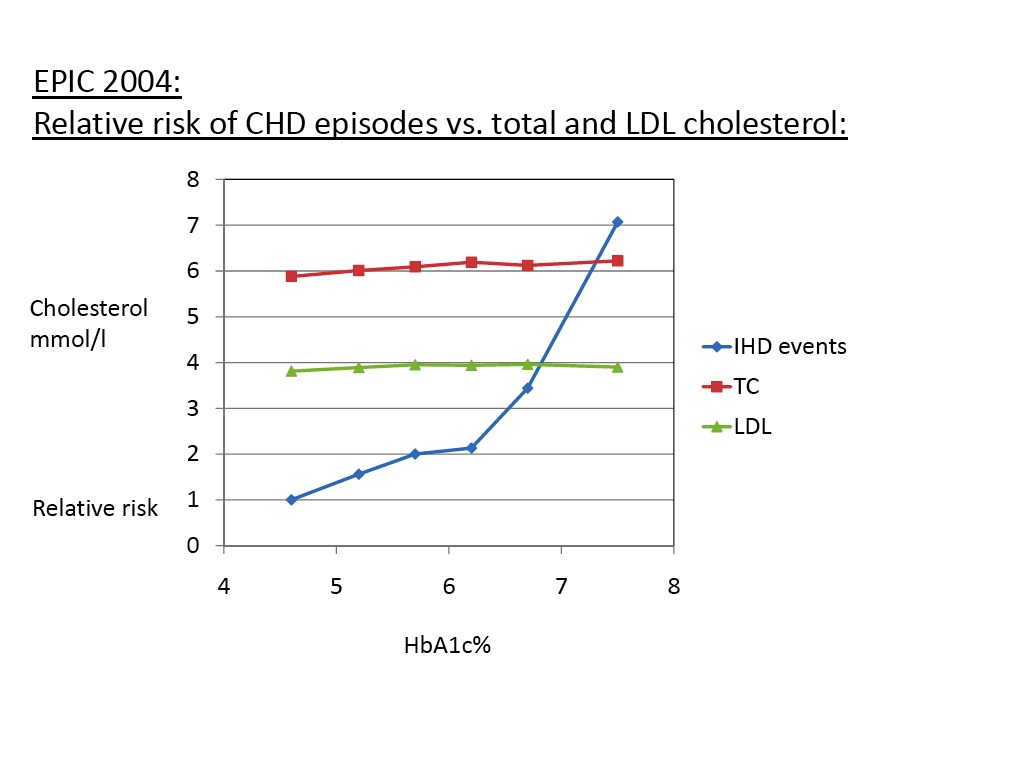
The whole article is interesting, but the graph below is the kicker:

Notice that as HbA1c increases, particularly over about 6.2%, the risk of a cardiac episode increases dramatically.
Also notice that there is no indication that high cholesterol with a low HbA1c increases the risk of cardiac mortality.
In other words, an important goal for any heart disease prevention diet should be to minimize HbA1c. How do you do that? Minimize blood glucose -- and the most effective solution there is to reduce simple carbs and increase fat.
The whole article is interesting, but the graph below is the kicker:
Notice that as HbA1c increases, particularly over about 6.2%, the risk of a cardiac episode increases dramatically.
Also notice that there is no indication that high cholesterol with a low HbA1c increases the risk of cardiac mortality.
In other words, an important goal for any heart disease prevention diet should be to minimize HbA1c. How do you do that? Minimize blood glucose -- and the most effective solution there is to reduce simple carbs and increase fat.
Thursday, 15 April 2010
Which salt to use?
The sea salt I use (Lotus Macrobiotic Sea Salt / fine grain) is 83% sodium chloride and 7% water. A full 10% is a mix of about 80 different minerals, including potassium, sulphur, zinc, magnesium, potassium, manganese, copper, calcium, silicon, iodine and more. It is slightly gray in color, and somewhat chunky (although it dissolves very easily in water).
In comparison, standard table salt is 99.9% sodium chloride. In addition to 0.01% potassium iodide, it sometimes has things like aluminum silicate added to help it stay powdery (some brands also have a small amount of sugar added to them). I think of table salt more as a drug than a food.
[[MORE]]I've tried a number of different brands of sea salt. They vary depending on where and how the salt is harvested and cured/dried. I've noticed a surprising difference in taste from one brand to another. The Lotus brand I mentioned above comes from Spain. I've had another brand that originates in Baja California that's also good. I haven't enjoyed the "Celtic" brands nearly as much.
An tidbit from a (long-term!) evolutionary perspective: human blood has
almost exactly the same concentration of salt as sea water. In fact, I recall reading that in an emergency, sterile sea water has been successfully used instead of blood or saline in people who have suffered from blood loss due to surgery or trauma.
In addition, one of the main techniques that industrial food processors use to increase the shelf life of food is to replace potassium with sodium (salt). Unfortunately, other trace minerals are also removed at the same time.
In comparison, standard table salt is 99.9% sodium chloride. In addition to 0.01% potassium iodide, it sometimes has things like aluminum silicate added to help it stay powdery (some brands also have a small amount of sugar added to them). I think of table salt more as a drug than a food.
[[MORE]]I've tried a number of different brands of sea salt. They vary depending on where and how the salt is harvested and cured/dried. I've noticed a surprising difference in taste from one brand to another. The Lotus brand I mentioned above comes from Spain. I've had another brand that originates in Baja California that's also good. I haven't enjoyed the "Celtic" brands nearly as much.
An tidbit from a (long-term!) evolutionary perspective: human blood has
almost exactly the same concentration of salt as sea water. In fact, I recall reading that in an emergency, sterile sea water has been successfully used instead of blood or saline in people who have suffered from blood loss due to surgery or trauma.
In addition, one of the main techniques that industrial food processors use to increase the shelf life of food is to replace potassium with sodium (salt). Unfortunately, other trace minerals are also removed at the same time.
Tuesday, 30 March 2010
Managing fruit cravings
I find myself many times confusing thirst for hunger. When I develop a food craving these days, the first thing I try to do is take a drink.
If the craving remains, a trick that I’ve used successfully with fruit is to reduce the quantity significantly, and then bury it in cream (unsweetened whipped cream works particularly well with berries). My wife jokes that I’m having a little fruit with my cream. The thing is, though, that it’s much easier to eat a huge bowl of fruit than it is to eat a huge bowl of cream; the cream works to activate satiety, where the fruit does the reverse. At least for me. The added fat also reduces the overall GI, which in turn helps minimize blood sugar swings.
If the craving remains, a trick that I’ve used successfully with fruit is to reduce the quantity significantly, and then bury it in cream (unsweetened whipped cream works particularly well with berries). My wife jokes that I’m having a little fruit with my cream. The thing is, though, that it’s much easier to eat a huge bowl of fruit than it is to eat a huge bowl of cream; the cream works to activate satiety, where the fruit does the reverse. At least for me. The added fat also reduces the overall GI, which in turn helps minimize blood sugar swings.
Friday, 26 March 2010
Measuring your nutrient levels
I have found that detecting and then correcting nutrient deficiencies is a very important aspect of treating a number of otherwise "resistant" health conditions. Accurate measurement of your current status is the first step.
Measuring nutrient levels is complicated by the fact that enzymes and molecular pumps in cell walls selectively create concentration gradients between the plasma and the inside of the cell for some nutrients. In general, measuring the level inside red blood cells, as opposed to in the plasma, results in the measurements that most accurately reflect functional ability. However, there are exceptions—for example magnesium, for which there isn’t really a good blood test (a loading test is the best measurement).
[[MORE]]There’s also another class of tests related to “functional” levels of both vitamins and minerals. I know a couple of docs and researchers that swear by those tests, but my personal experience with them hasn’t been very good (and they’re expensive).
You can get some sense of deficiencies from looking at trace mineral levels in hair. The advantage is that the test is cheap and easy to do. Unfortunately, those results are easily contaminated (even from things like chromium on the blades of scissors used to cut the hair, as well as shampoo contents). Mineral levels in hair are generally most useful for detecting heavy metals.
Here are links to a few labs that do the right kind of tests:
http://www.doctorsdata.com/home.asp
http://www.metametrix.com/content/Home
http://www.genovadiagnostics.com/
Correcting deficiencies is a whole other art and science, because so many factors are involved: everything from stomach acid to minerals that compete, to gut dysbiosis, to the form of supplement that’s used, associated microcontaminants, competing foods or drugs (including alcohol), etc, etc.
Measuring nutrient levels is complicated by the fact that enzymes and molecular pumps in cell walls selectively create concentration gradients between the plasma and the inside of the cell for some nutrients. In general, measuring the level inside red blood cells, as opposed to in the plasma, results in the measurements that most accurately reflect functional ability. However, there are exceptions—for example magnesium, for which there isn’t really a good blood test (a loading test is the best measurement).
[[MORE]]There’s also another class of tests related to “functional” levels of both vitamins and minerals. I know a couple of docs and researchers that swear by those tests, but my personal experience with them hasn’t been very good (and they’re expensive).
You can get some sense of deficiencies from looking at trace mineral levels in hair. The advantage is that the test is cheap and easy to do. Unfortunately, those results are easily contaminated (even from things like chromium on the blades of scissors used to cut the hair, as well as shampoo contents). Mineral levels in hair are generally most useful for detecting heavy metals.
Here are links to a few labs that do the right kind of tests:
http://www.doctorsdata.com/home.asp
http://www.metametrix.com/content/Home
http://www.genovadiagnostics.com/
Correcting deficiencies is a whole other art and science, because so many factors are involved: everything from stomach acid to minerals that compete, to gut dysbiosis, to the form of supplement that’s used, associated microcontaminants, competing foods or drugs (including alcohol), etc, etc.
Subscribe to:
Posts (Atom)